|
|
Ecological
Economics ENVS 6115 Mondays, Brian
Milani <bmilani@web.ca> |
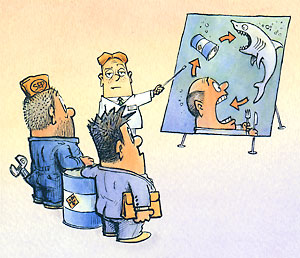
Image Courtesy of Seppo
Leinonen and his EnvironMental Cartoon Gallery
Schedule
& Readings
Week 1. January 8
Overview and Introductions
Week 2.
January 15 Paradigms & Perspectives
Herman Daly, Ecological Economics: The Concept of Scale and Its Relation to
Allocation, Distribution and Uneconomic Growth. 2003 CANSEE conference,
Jasper

Ellie Perkins, Feminist Ecological
Economics And Sustainability, 2005 CANSEE conference, York University
Brian Milani, What Is Green
Economics? , Race, Poverty & the
Environment: A journal for social and environmental justice,
also published in Synthesis / Regeneration, #37
(Spring 2005)
Week 3. January 22 Dematerialization / Economic Growth
Donella Meadows, Jorgen Randers,
Dennis Meadows, The
Limits of Growth: 30-year Update, excerpt, Chelsea Green Publishers,
reprinted on Minnesotans for Sustainability website
Charles Siegel, “The
End of Economic Growth: The Limits of Human Needs,”
Read this EIJ article.
But if you want to read more on the social impacts of economic growth,
check out Siegel’s longer more recent mini-book, The End of Economic
Growth, Preservation Institute,
Ester van der Voet, Lauran van
Oers, and Igor Nikolic, Dematerialization:
Not Just a Matter of Weight, Journal of Industrial Ecology, Volume 8, Number 4
Week 4. January 29 Detoxification
Anne Platt McGinn, (2000). Why Poison Ourselves? A precautionary approach to synthetic chemicals,  (Worldwatch paper No. 153).
Washington DC: Worldwatch Institute.
(Worldwatch paper No. 153).
Washington DC: Worldwatch Institute.
Peter Montague, The
Trouble with the Precautionary Principle, Rachel’s Health & Environment
Weekly, December 14, 2006
David Morris and
Irshad Ahmed, executive summary, The
Carbohydrate Economy: Making Chemicals and Industrial Materials from Plant
Matter, report for the ILSR, 1993
Sandra Steingraber, The Pirates
of Illiopolis: Why your kitchen floor may pose a threat to national security,
Orion magazine, May/June 2005
Week 5. February 5 Closing Loops: Design / Flow / Scale
Helen Lewis and John Gertsakis, Introduction:
Design + Environment: A global guide to designing greener goods, Greenleaf
Publishers, 2001
Jouni Korhonen, “Some Suggestions For
Regional Industrial Ecosystems – Extended Industrial Ecology,” Eco-Management and Auditing, 8,
57–69 (2001)
Wendell Berry, Global Problems/Local
Solutions, Resurgence #206 (May/June 2001)
John T. Lyle, “Urban Ecosystems”,
In Context magazine, Spring 1993
Week 5.5. February
12 Block Week


Week 6. February 19 Trade & International Development
Aaron Cosbey, “Reconciling Trade and Sustainable Development,”
Chapter 8, State
of the World 2006,
Irving Mintzer &
Amber Leonard, Trade and
Consequences, World Watch, November/December 2005;
18/6.

Wolfgang Sachs, “Development: The Rise and Decline of an Ideal,” in T. Munn (ed.), Encyclopaedia of Global Environmental Change, August 2000
Stan Cox, “War, Murder, Rape…All for your cell
phone,” AlterNet,
Terrence McNally, “Globalization has increased the
wealth gap: Nobel prize-winning economist Joseph Stiglitz talks about what's
gone wrong with globalization,”
AlterNet,
Week 7. February 26
Money & Exchange
 Richard Douthwaite, The Ecology of
Money,
Richard Douthwaite, The Ecology of
Money,
Optional:
Eric Miller, A
Treatise on the Ecological Economics of Money, York FES, August 2005, and
CANSEE conference, October 2005
Eco-file Radio Show: Interview with Michael Rowbotham, author The Grip of Death: A
study of modern money, debt slavery and destructive economics
Tim Cohen-Mitchell, Community
Currencies at a Crossroads: New Ways
Forward, New Village Journal,
issue 2, 2003
Week 8. March 5
Climate Change
David Morris, “What Al Gore hasn’t told you
about global warming,” AlterNet, 
George Monbiot, “Here’s the
Plan,” The Guardian,
Alex Boston, Planning
for the Next Generation: 10 principles for Climate Protection and Innovation,
David Suzuki Foundation, May 2004
Stephen Hill, “Local Heroics,”
Alternatives journal, vol. 31, no. 4/5, 2005
Danny Bradbury, “The Trading Game:
Emissions trading schemes offer pollution as a market commodity,”
Alternatives journal, vol. 31, no. 4/5, 2005
Optional:
James Howard Kunstler, “Ten Ways to Prepare for a
Post-Oil Society,” AlterNet,
James Randall Kahn and
Dina Franceschi, “Beyond Kyoto: A tax-based system for the
global reduction of greenhouse gas emissions,” Ecological Economics, Volume 58, Issue 4,
Peter Gorrie, “GTA
Sitting on a Gold Mine: Huge inefficiencies in energy use mean huge potential
to save, guru says,”
 Eco-file Radio Show: Interview with Guy Dauncey, author Stormy
Weather: 101 Solutions to Global Climate Change
Eco-file Radio Show: Interview with Guy Dauncey, author Stormy
Weather: 101 Solutions to Global Climate Change
Stephen Colbert, Special Report: The
Convenientest Truth, powerpoint presentation, The Colbert Report, July 19, 2006
Stephen Colbert, Second
Opinion on Global Warming, Colbert Report,
Week 9. March
12 Regulation
Neil Gunningham and Darren Sinclair, “Regulatory Pluralism:
Designing Policy Mixes for Environmental Protection”, Law and Policy 21, 49-76,
1997
Brian Milani, “Mindful
Markets, Value Revolution and the Green Economy: EPR, Certification and the New
Regulation”, forthcoming, 2006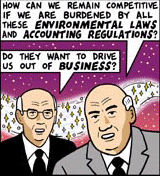
Michael Braungart, "Product Life-Cycle
Management to Replace Waste Management", in Socolow, Andrews,
Berkhout & Thomas (eds.), Industrial
Ecology and Global Change, N.Y./Cambridge:
Michael
E. Conroy, Certification Systems as Tools for Natural Asset Building: Potential,
Experience to Date, and Critical Challenges,
Working paper No. 100, Political Economy Research Institute (PERI), University
of Massachusetts-Amherst, July 2005
Brian Dunkiel, M. Jeff Hamond, and Jim
Motavalli, “Sharing the
Wealth: If We Shift the Tax Burden From Work to Waste, Everyone Benefits”,
E magazine, March/April 1999
Recommended:
Brian
Martin, Against
Intellectual Property, Chapter 3 of Information Liberation, London
Laurence Lessig, “Some Like It Hot,”
Wired magazine, issue 12.03, March
2004
 Optional:
“EPR: A
Prescription for Clean Production, Pollution Prevention and Zero Waste”,
Grassroots Recycling Network, August 2003
David Boyd, Canada vs. the
OECD: an Environmental Comparison,
Forbidden:
Stephen Colbert, The
Word: “Wikilobbying”, Colbert Report,
Al Franken, Vast Lagoons of Pig Feces: the Bush
environmental record, excerpt from Lies and the Lying Lyars who Tell
Them,
Week 10. March
19. Consumption
Michael Renner, “Moving Toward a Less Consumptive Economy”, Chapter 5,
pp. 96-119, from the State of the
World 2004, NY/Washington:
Worldwatch Institute, 2004
 Tim Jackson, “Is
There a ‘Double Standard’ in Sustainable Consumption?”, Journal of
Industrial Ecology, vol. 9, no. 1-2, Winter/Spring 2005
Tim Jackson, “Is
There a ‘Double Standard’ in Sustainable Consumption?”, Journal of
Industrial Ecology, vol. 9, no. 1-2, Winter/Spring 2005
Jacquelyn Ottman, Consumers
With a Conscience, chapter 2 of Green
Marketing: Opportunity for Innovation, New York: NTC-McGraw-Hill, 1998
Lisa Mastny, “Purchasing for People and
the Planet,” Chapter 6, pp. 122-142, from
the State of the World 2004,
NY/Washington: Worldwatch Institute, 2004
browse and
contemplate: The Interra Project [Will this work?]
especially: Interra Overview
video clips:
Optional:
Dara O’Rourke, “Market
Movements: Nongovernmental Organization Strategies to Influence Global
Production and Consumption,” Journal
of Industrial Ecology, vol. 9, no. 1-2, Winter/Spring 2005
Gary Gardner and Erik Assadourian, “Rethinking
the Good Life”, Chapter 8, from the State of the World 2004, NY/Washington: Worldwatch Institute, 2004
Joop de Boer: “Sustainability Labelling
Schemes: The Logic of Their Claims and Their Functions for Stakeholders”,
Business Strategy and Environment 12, 2003
book description and excerpts: Sharing the Work, Sparing the
Planet: Work time, consumption and ecology, by Anders Hayden, MES
The Overspent
American, dialogue with Juliet Schor and leaders of the voluntary
simplicity movement, Yes! magazine,
summer 1998
James Westcott, “Shop Till You Stop”,
AlterNet,
Links

Week 11. March 26. Student Presentations Marc, Shabnam, Kazi,
Tor, Howie,
Week 12. April 4.
Student Presentations Please
note time and day change for final class:
Wednesday 9:30 am, instead of
Monday Kate, Ryan, Kristin, Najat, Civi, Julia